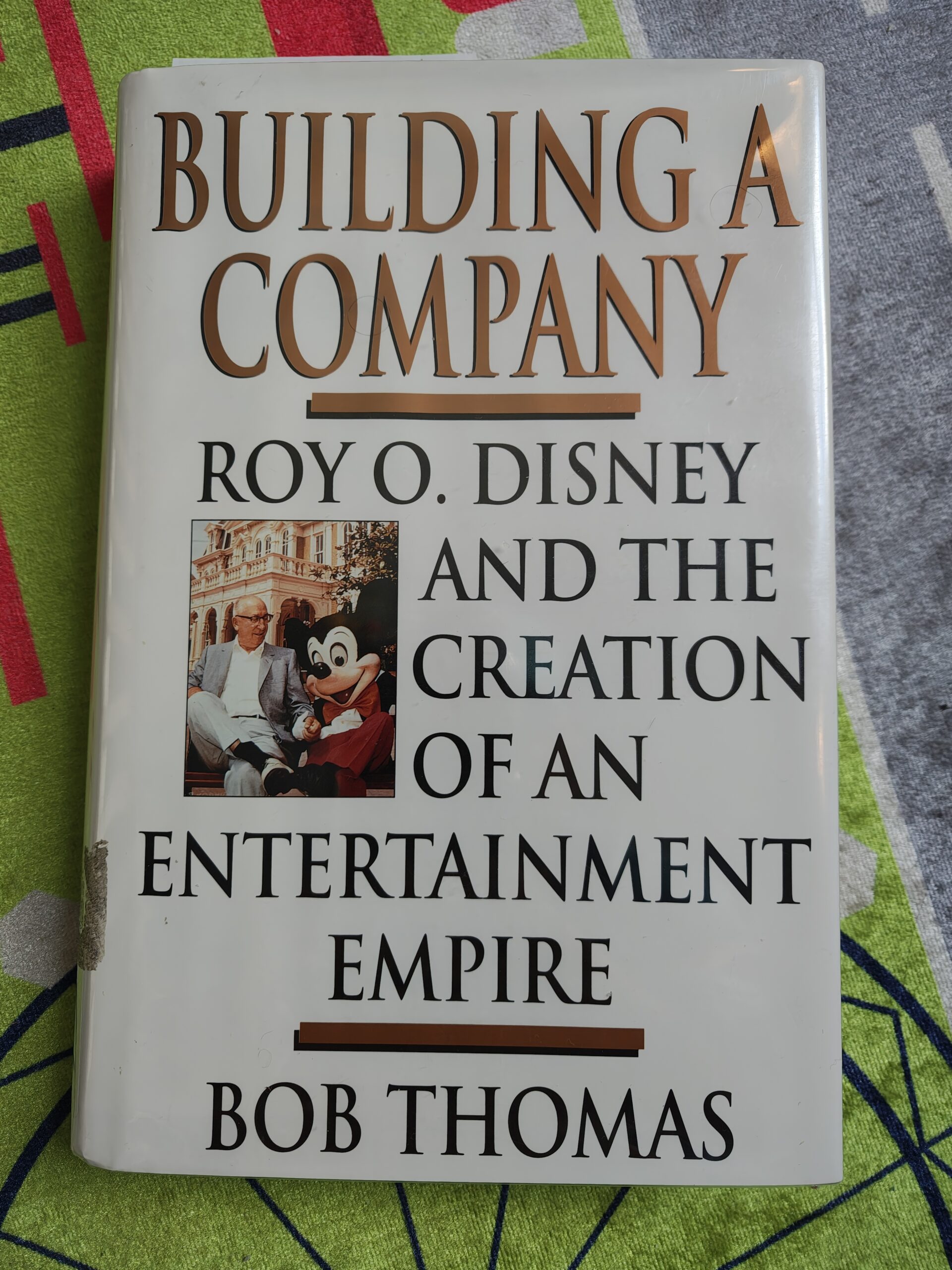
I just got through reading “Building a Company: Roy O. Disney and the Creation of an Entertainment Empire” by Bob Thomas. Reading nonfiction usually takes me a long time (I’m a daydreamer) but I absolutely sailed through this book. It’s all about Roy Disney, Walt Disney’s older brother and business partner. It’s a touching book. Though Roy became quite rich as a result of his association with Walt, he was also very self-sacrificing.
When Walt decided to start a new animation studio, Roy was in a hospital bed undergoing long-term treatment for tuberculosis. Walt said “I need your help” and Roy got out of bed and checked himself out of the hospital against medical advice. I almost cried at one point, reading about an incident much later, years after Walt had passed away. Roy was close to death himself, but had been working on the founding of CalArts, which had been a very frustrating process. A close associate asked “Why don’t you give it up?”
“Godammit(sic), Donn” Roy replied, vehemently, “Walt wanted this school, and I’m going to get it for him.”
p326
Something I’ve been thinking a lot about lately is how creative businesses don’t seem to be able to flourish in the 21st century. The simple explanation might be that the democratization of tools has made creating something truly original is tougher. The landscapes of the arts are fractured. Also, they don’t make creative people like Walt Disney anymore. There’s some truth to each of these explanations, but not fully true. Nothing is really original, all creative work stands in reference to prior work. The audience is fractured, but it always has been — in the past it was fractured by geography, language, economics, and politics. All of these are still factors, but for anything consumed through the internet they are decreasingly relevant.
And, though there might not be anyone quite like Walt Disney, there are lots and lots of wildly creative and driven people. Especially in the wake of Walt himself, there was a generation of creative people who was inspired by The Wonderful World of Disney television series showing behind the scenes moments of animation and imagineering. Generally, the business of entertainment has become more and more transparent (sometimes literally). I’d argue that these days there is no shortage of Walt Disneys. The problem is a shortage of Roy O. Disneys.
Roy had a lot of faith in his brother, and learned early on that he didn’t have the knack for creative decisions himself. As the primary financial voice in the Walt Disney Company, Roy calmly bet the whole company, or nearly did, on projects that were uncertain at best, like Snow White and Disneyland. He tried to mitigate the risk with clever things like subletting equipment when the studio wasn’t using it, and by partnering with distributors who would reimburse some of the production cost. However, when partnerships threatened Disney Co.’s control over its own destiny those ties were quickly severed.
Roy didn’t pretend to understand the merits of these projects, though Walt would of course spin a yarn about the potential financial upside. It seemed as though he didn’t feel that he needed to know why his brother and his team was choosing one creative path over another. He trusted both that Walt had the best interests of the company at heart, and trusted in his own team’s ability to make financial projections of their performance.
In my own experience in the games industry, I’ve encountered more than a handful of Walt-level creatives, but very few producers or executives with the temperament of a Roy. I’m not in a position to know why, but I would guess that people who find themselves in control of a games company are usually educated with an MBA, a finance degree, etc., and those institutions teach a level of caution and responsibility that allows a business to avoid failure. But Roy was self-educated, and had seen his father’s businesses fail again and again throughout his childhood and young adulthood. His fear of failure must have been attenuated by that experience.
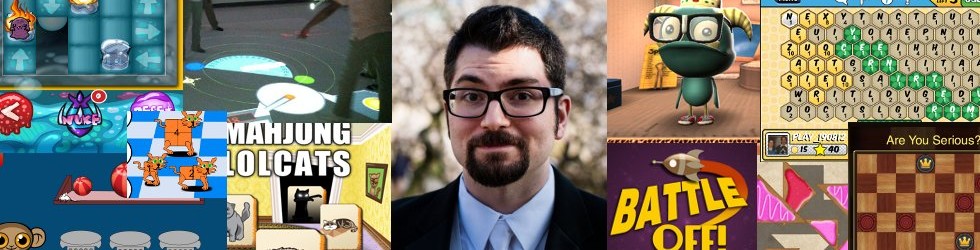
As an outsider to Meow Wolf (in my opinion the most exciting creators of themed entertainment working today), their CEO Vince Kadlubek feels like a Roy-ish figure. If you watch the documentary of Meow Wolf’s founding story, you’ll see that Vince began as a creative, but seeing himself surrounded by Walts he chose to mold himself into a Roy.
Personally, I have been searching for my own Roy for years. I’m a very creative person (I work on Video Games, Installation Games, Toy Inventions, and books), and very entrepreneurial, but I know that I don’t have a disciplined personality or a knack with money. I need a Roy. Where are they?