Blog Archives

Teaching Computer Programming Digitally: Is Constructionism Enough?

Racetrack

It all started with LOGO.  If you don’t remember making this little turtle crawl around and draw stuff, then your childhood wasn’t complete.  In fact, you should probably go back and do it now.

I like TURTLES
fwd 20 lt 90 fwd 40

Seymour Papert, a researcher at MIT, reasoned that children could learn programming more easily if they were given a fun programming environment to play around in.  This was so successful in the case studies he observed that he was forced to develop an explanation.  He called his theory of learning ‘constructionism’ (because the student can construct their own knowledge by experiment).  This spawned a genre of software toys designed to teach programming (all after my time, unfortunately).  Toys like Alice, Greenfoot, RoboMind, GameStar Mechanic (my favorite), and Scratch (the most popular).  Even Lego’s robotics platform, Lego Mindstorms is an extension of the ideas Papert outlines in his books ‘Mindstorms‘ and ‘The Children’s Machine‘ and is perhaps the most faithful to them.

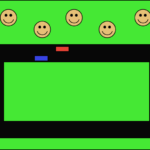
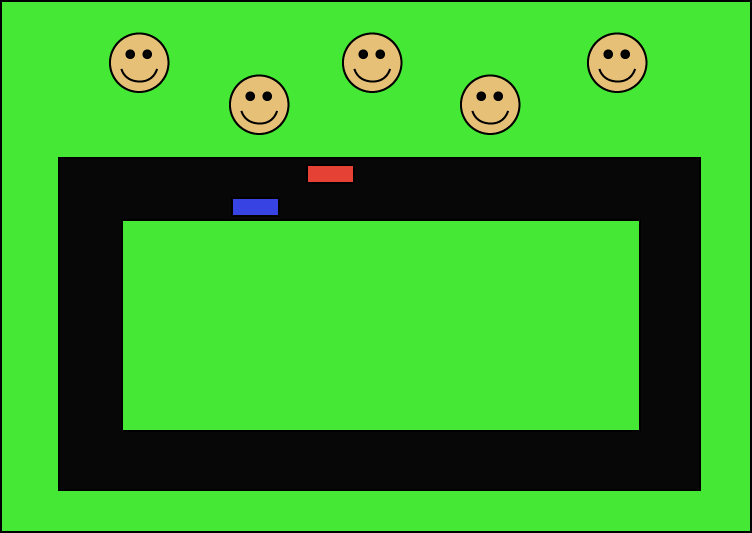
These efforts have engaged millions of students in learning about technology, and has given them great early exposure to the field.  In my own first grade class, we had a teacher (I think his name was Mr. Costa) who took care of the computer lab and taught computer class.  We were taught the basics of LOGO, and then asked to produce a project of our choosing.  My partner and I worked diligently to put together an animated scene of an F1 racetrack, complete with cheering fans and cars circling the track.

racetrack
In my mind, it was amazing, but it probably looked like this.

We were very proud to present what we’d done to the class, but when the time came we found out that we were the only group out of 10 or 12 who had actually done anything substantial.  A few pointy spirals.  A few rounded spirographs. Disappointing.  The next year Mr. Costa was replaced, and our ‘computer class’ was about typing and learning to use Microsoft Word.

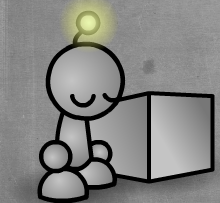
Maybe I was just the right kind of kid to get hooked on programming early, but for most of the first-graders in my class, the motivation just wasn’t there.  That’s what I see as a lack inherent in these toys built with constructionism in mind: motivation.  Why am I exploring this educational environment?  What am I supposed to do here?  When some students are told “you can do anything,” what they hear is “there’s nothing to do.”

In my case, I was motivated by curiosity.  For many people, motivation is more extrinsic.  Code.org lists resources for motivated adults to learn how to code, usually for career-oriented reasons.  Kids in the third world, and everyone in the eighties, when Papert was doing his work, are at least somewhat motivated by the novelty of interacting with the machine itself.

Woooooo!

Today, getting to interact with a computer is not such a treat.  For many school-age children in the US, it’s the default state of being.  The software has to have a better ‘why’ built into it.  That’s where games come in.

Many authors have written (more eloquently than I ever could) why games are such a perfect learning environment.  Central to those arguments is the concept of intrinsic motivation.  Winning a game is gratifying for its own sake (there’s evolutionary hard-wiring there).  Games, ideally, keep players always at the edge of their capabilities, wanting to get better to accomplish the next task and unlock the next bit of power-up or narrative or whatever digital carrots the game designer decides to add.  Games also offer a kind of social capital that creative tools cannot;  creative work cannot be compared quantitatively in the way that a score or level can.

Until recently, there haven’t been many efforts to create an actual Game that teaches programming.  Let’s go over a few.

Screen Shot 2013-09-04 at 4.36.21 PM

Light Bot

This is going to stand in for a whole bunch of what are essentially puzzle games, like Daisy the Dinosaur and Robozzle.  I’ve got nothing against puzzle games, and I think any game that adequately introduces the mechanics of programming has to have a puzzle component.  That said, puzzle games are the genre of game most like homework.  These games in particular don’t introduce any kind of stakes – no reason to complete the puzzles.  Also, one of the principles of responsive games is to decrease, as much as possible, the (user input)/(in game consequences) ratio.  By their nature, these kinds of puzzles require a lot of player input for very little onscreen action.

I titled this section after Light Bot because it’s actually the best I’ve seen in this category, but most entries in the category are characterized by very little professionalism.  It’s easy to speculate on the creator’s thought process. “I’ve never made a game before, but I’m a programmer, so how hard could it be to make a game about programming?”

CodeHero

Code Hero (unfinished)

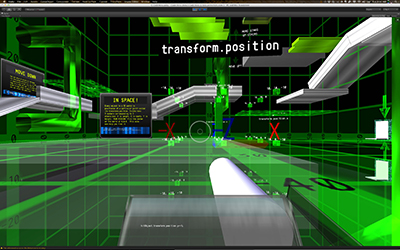
There’s been a lot of hubbub about Code Hero recently, but the concept is still an exciting one.  It uses the concept of the action-puzzle game, popularized by games like Portal and Quantum Conundrum.  It also gives the player a first-person perspective, so they can feel situated in this world where code is so important.  It reminds me of something Papert says in ‘The Children’s Machine’: “What would happen if children who can’t do math grew up in Mathland, a place that is to math what France is to French?”  In Code Hero, you grow up in Codeland.  I am anxious for the Primer Labs team to continue development.

The one criticism I have is that this game (and Portal) feel a bit contrived.  I’m in some kind of laboratory environment where I have to complete spatial reasoning puzzles…because…things?  In Portal they call it like it is — “tests.”  A robot is testing you, to see how clever you are.  That narrative conceit (which was always a cop-out) can only be used once.

CodeSpells

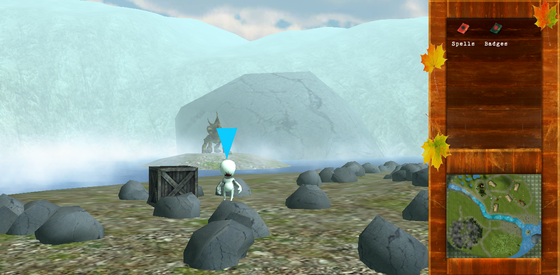
Code Spells (unfinished)

Code Spells has all the situated-learning benefits of Code Hero, but also addresses my criticisms by placing the player in a fantasy world where she must help little gnomes to complete tasks.  Meanwhile, there is a monster roaming around.  The idea of code-as-magic is one that I love.  It explains why magic is so often botched and broken, why it takes a lot of concentration and diligence, and why it is best practiced by ancient masters.

All my criticisms of this game are a consequence of it simply not being finished.  I can’t wait to see what the team at ThoughtStem adds next.

codemancerlogo_web

Codemancer (unfinished)

I independently decided to use the magical-programming metaphor for a game I’m developing called ‘Codemancer’ which I’m not ready to talk about in detail, but which I hope will be an example of how to do this genre right.  The main difference in my game is that it has a less specific focus.  I thought it would be better to develop my own visual programming language (which has a lot in common with LOGO), so I could make the basics as accessible as possible.  I hope you’ll follow along in its development by following me on twitter here.

I’m not proposing that constructionist learning environments be eliminated.  Whether a student responds to an exploratory style depends on the individual student, and indeed many students respond well.  There are, I believe, a lot of learners who are underserved by making exploration the only means of discovery.  I’m excited for the time, approaching soon, when these learners will have the option of a more narrative, guided, fun-motivated way to learn programming.

PS – If you have a game about programming you’d like to see mentioned, please add it as a comment to this post and I’ll try to play it and add my thoughts.

Category: Uncategorized

Science Game Jam at the Field Museum

Posted on by
Smallsciencejamlogo

The last weekend in July, the Field Museum of Natural History and more specifically the Biodiversity Synthesis Center (with a little help from me) hosted a 48-hour game jam with a unique theme.  Each team of game developers was paired with an actual researcher in a sub-field of biology.  We called it the Science Game Jam at the Field Museum, and it was an amazing experience. SmallScienceJamLogo_2

Long before any part of the event was planned, I mentioned that something of the kind might happen on the IGDA Chicago page, and to the Indie City Games group (the two biggest forces in Chicago’s game scene).  The amount of enthusiasm I received was overwhelming.  It was as if all the game devs in Chicago shouted YOU MUST DO THIS.

The director of BioSynC, Audrey Aronowsky, and I planned it out and put up an Eventbrite page.  Despite being nearly a month before the event, the tickets sold out within the first three days, and later dropouts were replaced quickly.  Even so, I was skeptical about the attendance of people who sign up for a free event, but when all was said and done 90% of those who signed up actually came. On the day we started, everyone arrived and immediately chowed down on Indian food.  This alone should tell you how atypical this game jam was.  Audrey insisted that the event be catered and comfortable.

Developer Stephen Meyer struggles to ignore a half-eaten cookie.

Developer Stephen Meyer struggles to ignore a half-eaten cookie.

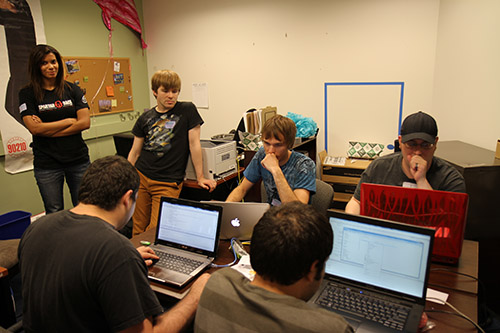
When everyone was settled, 8 scientists took the stage in turns: Courtney Stepien, Aaron Olsen, Tim Sosa, Jonathan Mitchell, Tom Stewart, Joanna Mandecki, Max Winston and Dave Clarke .  These are early-career scientists; still passionate about their field and open to new ways to bring their science to the public.  Each had 5 minutes to describe his or her research.  The organisms studied ranged from Algae to Army Ants to Pirahna, but there were underlying questions that many of the researchers shared.  Why did this trait evolve the way they did?  How do these species interact with one another?  The game developers had a lot of questions, too.  Some were whimsical, others showed a deep interest in the scientist’s work.

Then came the whirlwind process of team formation.  I asked each group of developers to come up to the front with a list of names of developers on their team, and then to request a specific scientist to join their team.  As written, this sounds like a neat and orderly process, but the reality was far from organized.  People scrambled to pull together their teams in order to claim ‘dibs’ on the scientist of their choice.

For the rest of that Friday night, while the party people of Wrigleyville and Wicker Park danced and drank and forgot their phones in the bathroom, a gang of game developers gathered inside a museum to grill a scientist on the details of the Rove Beetle’s mandible structure and the eating habits of the modern-day Raptor.

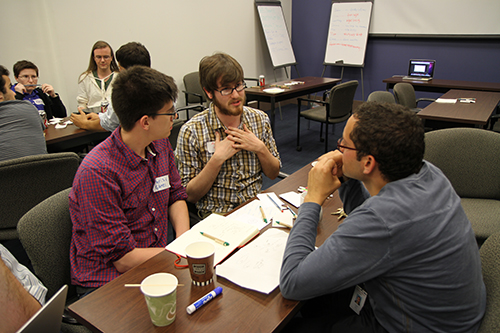
Game developers and scientists worked so well together, it was as if the two disciplines were separated at birth and reunited.  In a manner of speaking, they have the same parents: systems and rules.  They spent the night learning about each other’s systems, each others rules, and found the descriptions eerily similar.  It was an inspiring night, when the game they made that weekend could still be anything, and there were no such thing as programming errors or compatibility issues.

A scientist and a game designer learning each other's language.

A scientist and a game designer learning each other’s language.

Some teams dove in immediately – catching only a few winks on the floor over the course of a long night.  Some went home to sleep in their beds one last time, and to reflect on their game concepts.

Teams varied widely.  Some were basically a loose collection of mavericks working towards a common goal, like Rachel Ponce and her ‘Army Ants’ team.  Some were formed around a set of people who work together often, like The Men Who Wear Many Hats.  Some participants were hardcore veteran Game Jammers, like Dave “Jacksmack” Fulton.  Some were new to the idea of a game jam, like artist Pui Che.  One team decided against making a digital game entirely, instead crafting a board game.  That team had just two people, Chris Klein and Brian Gabor.  Some had as many as six, not including their chosen scientist. Game developers in Chicago are not a small group of people, but we’re pretty tight-knit.  I previously knew or had met around 75% of the people who participated.  The rest, I’m glad I know now.

The next day, I asked Patrick Hoover to come in and talk to each of the teams.  Patrick is an instructional designer at the Chicago Quest middle school, and spends a lot of time assessing the educational merits of particular game designs.  I sat in on a few of his meetings.  It was fascinating to me how he made it clear which directions were most promising pedagogically without ever offering an overt suggestion. “Oh, it’s really fascinating that you chose to emphasize that,” he’d say, by way of encouragement. Good friend Andy Saia also dropped by on Saturday to act as a troubleshooter for those who had gotten themselves in technological trouble.  I think people mostly appreciated the assistance these two experts brought, though no one would have faulted a team that wanted to be left alone for the sake of productivity.

The team behind "The Tide" had show-and-tell every few hours and literally applauded each other's achievements.  They became known as 'the team that claps.'

The team behind “The Tide” had show-and-tell every few hours and literally applauded each other’s achievements. They became known as ‘the team that claps.’

We closed the venue on Sunday morning at 2AM, sending a few die-hards and out-of-towners to a nearby hotel until 6AM at the earliest.  It was a refreshing mandatory break that allowed everyone to progress much faster on the third day.  Games actually started to look like games as new art and gameplay features were added.  Moods brightened.  “We’ll have something to show,” more than one game developer told me with a smile on their face.

At 5PM, it was pencils down. For the first time since the scientists gave their presentations on Friday, we gathered everyone in one place.

Judges arrived.  I’m proud to have gathered an amazing group of judges to weigh in and give their opinions of the games.  The judges were Ken Angielczyk, Curator of Paleomammology at the Field Museum, Jay Margalus, President of Lunar Giant Studios, Kyle Bailey, Lead Programmer at Phosphor Games, and Jake Elliot, Designer at Cardboard Computer.

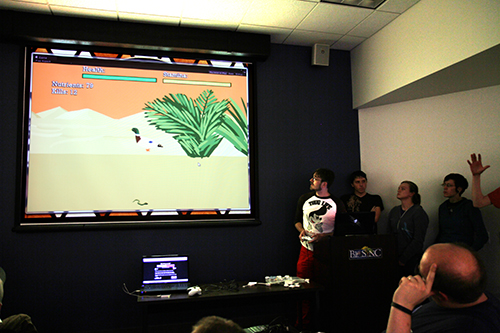
Just as the scientists each had five minutes to summarize their research, game development teams each had five minutes to summarize their games.  Five minutes in, five minutes out.  This was the first time some of the developers saw what their colleagues had been working on.  We paused for dinner, and to deal with the unavoidable technical problems that come with connecting so many machines to a projector in sequence.  When the presentations were over, there was palpable relief in the air.  The hard part was over.

Ryan Wiemeyer presents for his team, "Birds Eat Everything"

Ryan Wiemeyer presents for his team, “Birds Eat Everything”

The judges gathered in an outlying conference room to deliberate.  There were three prizes awarded: The Jury Prize, selected by the judges, the Science Prize, selected by the consensus of participating scientists, and the People’s Choice, selected by a vote taken among the game developers.  The three prizes were awarded with a lot of applause and enthusiasm, but everyone recognized them as tokens of an achievement they all shared.  Every person who participated made a game (hard) in 48 hours (brutal) about a topic in biology (impossible).  Through a thin layer of fatigue, you could see pride on everyone’s face as we all said our goodbyes.

Game Jams always feel like a bubble in reality, or an alternate dimension.  A place you can go, but you can’t stay.  It almost feels as if time stops during a game jam, and your friends and loved ones outside continue to age while you trade immortality for isolation.  But, knowing that it cannot last, the game jam can be glorious, and this one was doubly so. Thanks to Audrey Aronowsky, the Biodiversity Synthesis Center, the Field Museum, the amazing judges, the fantastic scientists and everyone who participated.  It was a weekend we can all be proud of.

You can view the entire game jam on youtube here, and 8 more polished short documentaries are being produced by the Biodiversity Synthesis Center and will be available shortly.

Robert Lockhart is Creative Director (and nearly everything else) of the Educational Games Studio Important Little Games.  You can follow him on twitter @bobbylox

Category: Uncategorized

Important Little Games

Posted on by 0 comment

I’m proud to say that I have started my own educational games studio called ‘Important Little Games.’  You can find out more about it here.  Under the ILG banner, I’m doing contract work as a designer and developer of educational games.  I’m also working on an original game called Codemancer, which I’ll hopefully speak more about soon.

Thanks to all of you folks who continue to support me doing what I feel I’m meant to do.

Category: Uncategorized

Naming This Studio

Posted on by
Ilg logo small1

The observation strikes me as funny: Almost anything you’d want to create in the 21st century starts with registering a domain name.  But before you can register a domain, you need a name for this thing.  Well, my thing was an indie game studio, and coming up with a name was not easy.

I'd have gone with 54RAH

More specifically, it’s an educational games studio.  My inspiration to create educational games, of a certain sort, was inspired by the book “The Diamond Age” by Neal Stephenson.  Described in  that book is an amazingly effective educational video game called ‘A Young Lady’s Illustrated Primer’ or just ‘The Primer’ for short.  My ING savings account for starting a studio was called ‘Primer Fund.’  Unfortunately, when the time came, there was no way I could use the name ‘Primer,’ in any form, mostly out of deference to Primer Labs, creators of Code Hero (who, I happen to know, were inspired by the same book).

So, what to call an educational game studio?  I started by putting together some portmanteaus of ‘Game’ and ‘Learning.’  Names like

Plearn

Playcademy

Luducation

Funstitute

Institute of Higher Gaming

etc.

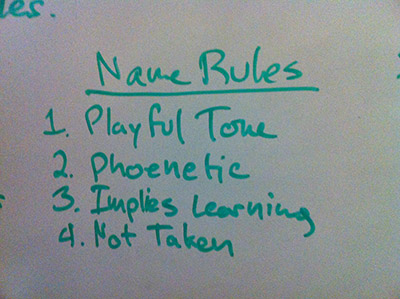
On a gut aesthetic level, I didn’t like the direction I was headed (though, if you like any of these names, go ahead and use them).  None of them seemed to trip off the tongue, and they all reminded me a bit of the buzzword Edu-tainment, which is a big turn off.  It seemed like I was flying blind – I needed a plan.  So, I came up with a set of criteria for determining whether something was a good name for my nascent studio.

Name Rules: Playful Tone, Phoenetic, Implies Learning, Not Taken
Game Designers make rules, I guess.

Very soon, #4 became my biggest problem.  There are lots of good names for a game studio, but there are also lots of game studios.  One of my favorite rejected names was Epicycle Games.  I pictured a logo with a man riding a bicycle whose wheels had wheels.  Turns out that name was already taken by the guys who made ‘Blindside,’ but who for some reason don’t own the .com?  Get on it, guys.

It turns out there are a lot of things online that need checking:

Does someone own the .com?  Are they actually using it or just squatting?

At my old job at Toy Studio, the CEO was willing and able to go chasing after domain owners and to negotiate inflated fees for their posession.  At the moment, I am completely unwilling to spend my meager allowances of and time and money in this way.  That meant I really had to come up with something unique.

Does someone have search priority?

I wanted my studio’s website to be the first google result for it’s name, even without doing any kind of SEO nonsense.  This means that it can’t be a phrase that a very popular website has included somewhere, and it can’t be the ‘title’ of a website with a different url.

Does someone have the twitter handle?

This is a lot less important because the actual twitter handle and associated username need not be the same, but still might cause confusion – at least until the studio is influential enough that it gets verified by twitter.

I had a couple of choices lined up that might have fit these criteria, but after hemming and hawing for about 6 hours, and chatting with Chicago Game Dev friends, I settled on “Important Little Games.”

So far I’m very happy with the name.  I get only positive remarks about it (though it would probably be a pretty mean move to say something negative right off the bat), and it’s met all my needs and expectations.  There are only a few things it doesn’t address well, namely

It doesn’t necessarily imply games for learning

I think this is actually a blessing, in a way, because it gives the studio more flexibility.  If the studio tacks a different direction we don’t have to change the name.  On the other hand, there is the connotation of importance, which is related.

The twitter handle cannot exist

It turns out that @importantlittlegames is too long for twitter to accept as a handle, so I had to settle for @importantgames and hope that it doesn’t sound too pretentious without the ‘little.’

I think that these are an acceptable tradeoff.

The next stage was to figure out the logo.  â€˜Important Little Games’ doesn’t imply a lot of visual information to go on, so I was going almost from scratch.  My first thought was to make an ‘important little guy’ like a general who tries to hide his gaming habit from his subordinates.  While I still like the concept there, it wasn’t a succinct enough image to use for all the multifarious purposes that a company logo may be put to.

ILG_Man_Logo

My favorite rejected concept was the silhouettes of a duck, another duck and a goose all in a row.  Due to unfortunate anatomical similarities, people I showed this to thought that the ducks were goslings, or that the goose was a giant duck of some kind.  Anyway, nobody got the joke.  However, the idea of using a ‘little game’ to represent the company, and giving it some importance through form and presentation appealed to me, and I came up with this:

ILG_Logo_small


Rob Lockhart is Creative Director (and nearly everything else) of the 1-man studio ‘Important Little Games.’  You can follow him on twitter @bobbylox

Category: Uncategorized

GDC Bound

Posted on by 0 comment

gdc13This week I will be away at the Game Developers Conference in San Francisco.  This will only be my second year attending. Last year, by sheer luck, I was invited to give a talk about designing games for HTML5.  This year, despite my best efforts, I was not invited back as a speaker, so I’m attending as a pure spectator.  However, the whole experience is sure to be just as cool.  Last year I met a lot of amazing people, some of whom I still keep in touch with.  It also gives me a chance to see what’s bubbling up in the game development community’s collective psyche.  Maybe there are trends worth joining, or worth shying away from.

Chances are, a lot of you are visiting my website because you just met me at GDC.  If so, hello.  I hope I made a good first impression.  My more substantial posts about game design are on my Gamasutra blog.

In any case, wish me luck!

Category: Uncategorized

Hello world!

Posted on by 0 comment

Welcome to my new website.  The old website still exists.  I find it a little embarrassing at this point, but if you insist on visiting it, you can go here.

Category: Uncategorized